
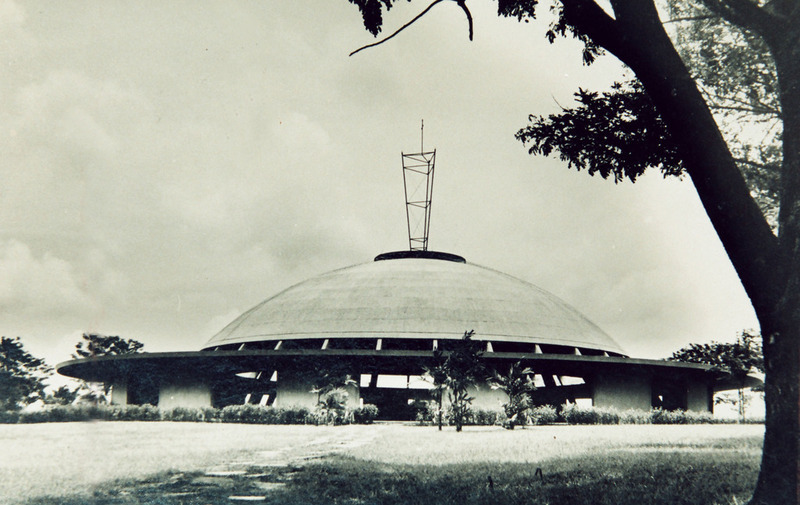
Nestled within the vibrant heart of the University of the Philippines Diliman campus, under the Diocese of Cubao and the Vicariate of San Jose, stands an iconic structure. Affectionately dubbed the “Flying Saucer,” “UFO,” or Simbahang Bilog (Round Church) by students and locals, the Parish of the Holy Sacrifice is much more than an architectural landmark—it is a living, breathing community of faith.
From its humble beginnings as a makeshift stable to becoming a National Historical Landmark and Cultural Treasure, the story of the parish reflects seven decades of continuous prayer, community sacrifice, and deep devotion.
The Sawali Chapel & Father John Delaney, SJ
The roots of the parish trace back to the late 1940s when UP Manila relocated to its Diliman campus in 1949. Father John Delaney, SJ, appointed as spiritual advisor and chaplain for the UP Student Catholic Action (UPSCA), arrived to find an abandoned US Army horse stable made of woven sawali.
With the collective energy of students, faculty, and campus employees, this humble sawali stable was lovingly transformed into a house of worship. In a small room behind the altar, Fr. Delaney offered confessions, spiritual direction, and pastoral care to anyone in need, day or night. Through his untiring devotion and warmth, Fr. Delaney nurtured a thriving Christian community in the heart of what many then called the “Godless University,” anchoring their lives in love for Jesus in the Holy Eucharist.
Built on Sacrifice: Constructing the UP Chapel
As the Catholic community grew, the little sawali chapel quickly became too small to accommodate the faithful. By 1952, plans were set in motion to construct a permanent house of prayer.
The construction of the church—inaugurated in December 1955 by Archbishop of Manila Rufino Cardinal Santos—was a true labor of love:
-
Faculty members donated portions of their monthly salaries to support construction funds.
-
Students made personal sacrifices, including organizing a 300-strong boys’ choir in 1952 for major fundraising drives.
-
On December 24, 1955, Fr. Delaney celebrated his first and last Mass inside the newly completed chapel before his untimely passing.
A Masterpiece of Faith and Art
The UP Chapel was groundbreaking for its time—becoming the first circular chapel and thin-shell concrete dome structure in the Philippines. The circular layout placed the altar squarely at the center, highlighting the centrality of the Holy Sacrifice of the Mass in the life of the faithful.
The chapel stands as a masterwork created by legendary Filipino artists and engineers who were later recognized as National Artists and pioneers:
-
Architecture: Leandro Locsin
-
Sculpture: Napoleon Abueva (The Hanging Crucifix with the Crucified and Resurrected Christ)
-
Visual Arts: Vicente Manansala and Ang Kiukok (Stations of the Cross), and Arturo Luz (The Rivers of Life floor mural)
-
Engineering: Alfredo Juinio, David Consunji, Felisberto G. Reyes, Jose Segovia, Agapito Pineda, and Lamberto Un Ocampo
In December 2005, the National Historical Commission of the Philippines officially declared the Parish of the Holy Sacrifice a National Historical Landmark and Cultural Treasure.
“Instaurare Omnia in Christo”: Empowering the Grassroots
In June 1977, Cardinal Jaime Sin officially elevated the chapel into a full parish, with Fr. Manuel “Manny” Gabriel serving as its first parish priest.
Fr. Manny spearheaded the formation of Basic Christian Communities (Ugnayan) across campus dormitories and residential areas within Barangay UP Campus. Guided by the motto Instaurare Omnia in Christo (“To restore all things in Christ”), the parish took the Church directly to the people:
-
Street Masses & Area Stations of the Cross: Celebrating faith out in the neighborhood streets and living quarters during Lent.
-
Dry Masses & Bible Sharing: Engaging lay ministers and residents to lead prayer gatherings and scripture reflections.
-
Lay Empowerment: Prioritizing active involvement from the poor, students, and everyday residents, reinforcing that faith begins at the grassroots.
Formation for National Leadership & Continuing Mission
As a university church, the Parish of the Holy Sacrifice carries a unique mission: forming the country’s future leaders. By pairing UP’s core values of Honor and Excellence with deep Christian faith and values, the parish aims to send out compassionate, ethically grounded leaders into broader Philippine society.
This missionary spirit shines clearly through the parish’s initiatives:
-
500 Days to 500 Years: To mark 500 Years of Christianity in the Philippines, the parish held 500 consecutive days of Holy Hours and Eucharistic Adoration starting November 18, 2019.
-
Year of Saint Joseph: Initiating the Society of Saint Joseph, weekly votive Masses, and community-driven outreach programs like Hapag ni San Jose—a community pantry providing hundreds of food packages weekly to those in need.
Moving Forward Together in Christ
More than 70 years since the days of the small sawali chapel, the Parish of the Holy Sacrifice remains a beacon of hope, unity, and devotion. Bound together by the Holy Eucharist, the students, faculty, staff, and campus residents continue to write the living story of a community united in faith, love, and service.