
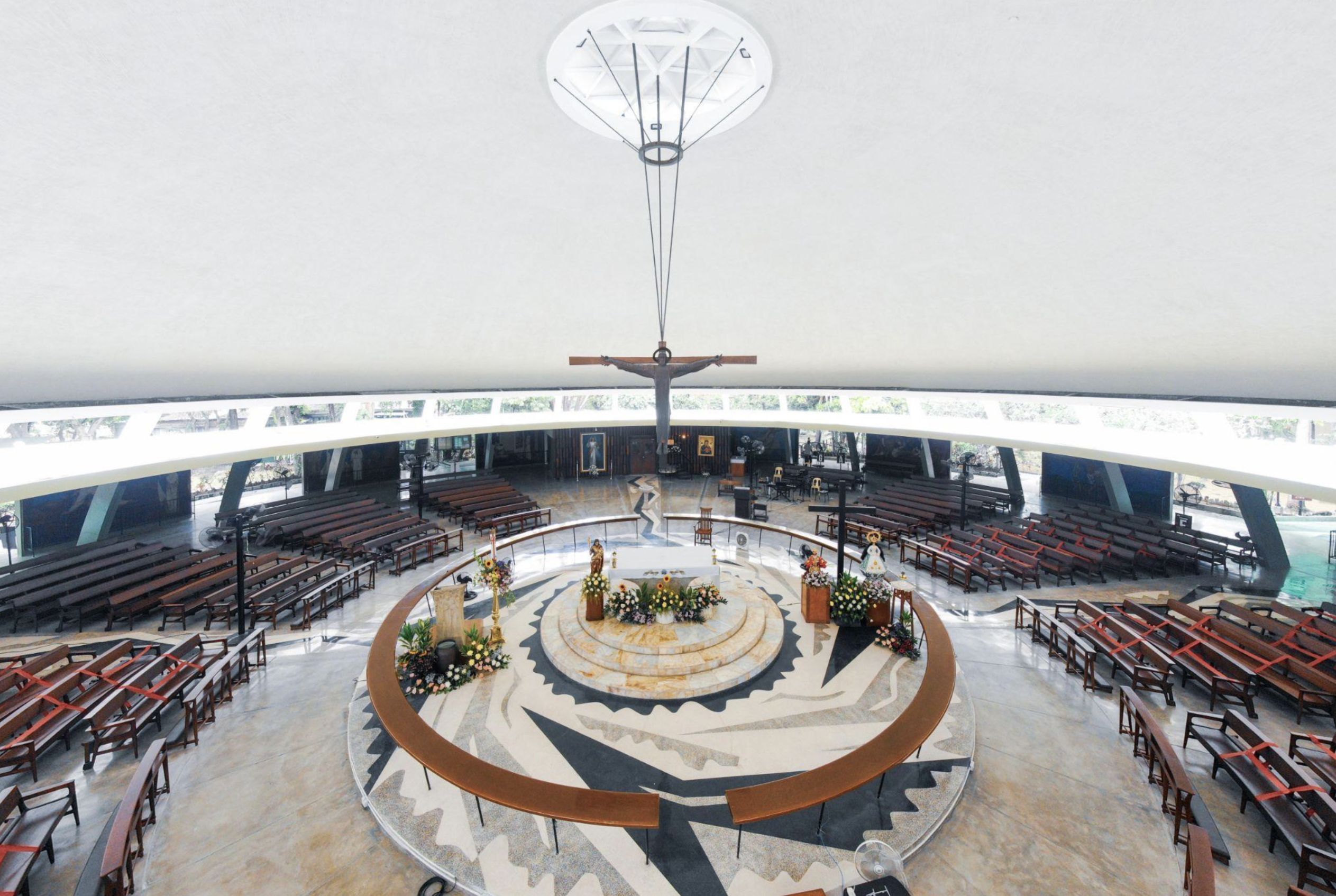
When you step inside the Parish of the Holy Sacrifice, your eyes are immediately drawn in two directions at once: upward toward the soaring concrete dome, and inward toward the altar standing at the exact center of the floor.
Designed in the 1950s by National Artist Leandro Locsin—years before the Second Vatican Council popularized “mass facing the people”—this unique circular sanctuary was revolutionary. But its design was never just about aesthetics; it was a profound declaration of faith.
1. The Altar at the Center: We Are One Table
In traditional church architecture, the altar sits far at the front, separating the priest from the congregation. Here, the altar is surrounded on all sides by the people.
This circular arrangement mirrors the early Christian practice of gathering intimately around the Lord’s table. No matter where you sit, whether on the left, right, front, or back, you are equidistant from the Holy Eucharist. It reminds us that in the eyes of God, there are no “front-row seats” or distant spectators. We are all active participants in the sacrifice of the Mass.
“The circular layout removes barriers. It visualizes the Church not as a hierarchy, but as the gathered Body of Christ.”
2. The Open Dome: Heaven Meeting Earth
The thin-shell concrete dome, a daring engineering feat of its era, serves as a physical representation of the heavens stretching over God’s creation.
Because the structure relies on a ring of exterior pillars rather than heavy interior walls, the chapel remains open on all sides. Fresh air, natural light, and the rustling sound of Diliman’s trees drift freely into the sacred space. This open design carries two beautiful spiritual meanings:
-
Inclusivity: God’s grace cannot be boxed in. The church has no heavy wooden doors blocking the outside world; anyone passing by can look in, enter, and pray.
-
Faith in Daily Life: The open boundary reminds us that our faith is not separate from the world outside. As you pray, you remain connected to the campus, the community, and nature.
3. The River of Life: Our Shared Journey
Radiating outward from the altar across the floor is Arturo Luz’s famous terrazzo artwork, the River of Life. The lines flow smoothly toward the altar and outward toward the open perimeter.
It tells a silent story: we bring our lives, struggles, and prayers from all directions to the altar at the center, and from that same center, we are sent out into the world transformed by grace.
Experiencing the Space
The next time you attend Mass under the dome, take a moment to look across the altar at the faces of your fellow parishioners facing you from the opposite side. The architecture itself asks us to remember: we do not worship alone.